

WIDEN: ISAIAH 40:1-31
🌓 WAXING MOON: See the big picture – GO HERE 2ND


Moon & Marginalia carries one passage across a lunar month — Widen is where we sit with the waxing moon to see the links in the passage to grow in understanding as the moon grows. The whole Isaiah 40 cycle is free, start to finish. If you want to keep going beyond this cycle, you can upgrade to a paid subscription and get the next cycle and the archives (started August 2026).
OVERVIEW
Full Text
40:1-31
Big Idea
The God above all others is making a way home and will sustain them on the journey.
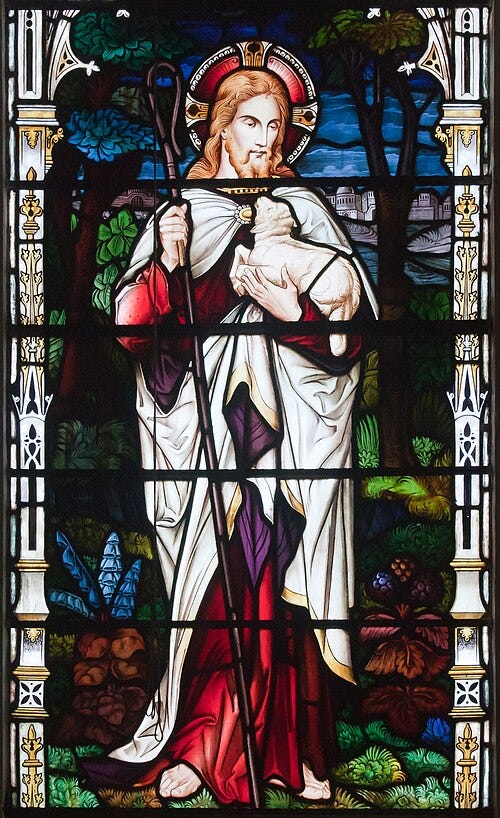
Church of St. Brendan the Navigator, Bantry, County Cork, Ireland
Detail of third window of the south wall with stained glass depicting Isaiah 40:11 He gathers the lambs in his arms. Created by Watson & Co, Youghal, in 1906.
Photo: Andreas F. Borchert, CC BY-SA 3.0 DE, via Wikimedia Commons
WIDEN
I started going to a Christian school in fourth grade. Like most Christian schools, our mascot was an eagle, and every week in our chapel services we would recite our school verse, Isaiah 40:31.
“But they that wait upon the Lord shall renew their strength. They shall mount up with wings as eagles, they shall run and not be weary, they shall walk and not faint.” (KJV, obviously)
I just typed that from memory. I guess saying it once per week for 9 years will do that. And while, I’m not crazy about verses out of context, this one does OKAY. But I think it’s even better in its context. So let’s examine what leads into it this week.
During this waxing moon, we are expanding our reference points for the passage — understanding how it connects to the larger book, its section, the rest of the Hebrew Bible, and the New Testament and beyond.
You can go as quickly or as slowly as you desire. Take a section each day or binge it all at once. You get to decide the pace that works for you. There are some questions to think on if you’d like to process further, but like everything, it’s optional.
Note: I will use Second Isaiah and Deutero-Isaiah interchangeably here.
Literary Style
What do you imagine it looks like for a prophet writing or delivering a prophecy?
(a) one prophet, one sitting
(b) one prophet across his lifetime
(c) not sure
What do we make of prophecy ANYWAY?
Prophecy in the Hebrew Bible is a way of God getting the people’s attention. Mediated through a prophet, the words are spoken and later written to share with us a message of judgment, repentance, or hope – and often all three. So yes, there is sometimes a “future vision” element, but it is often either a) very future as to paint the hope of restoration in worldwide terms or b) conditional as to say if you don’t repent, these are the consequences.
Who wrote this and why?
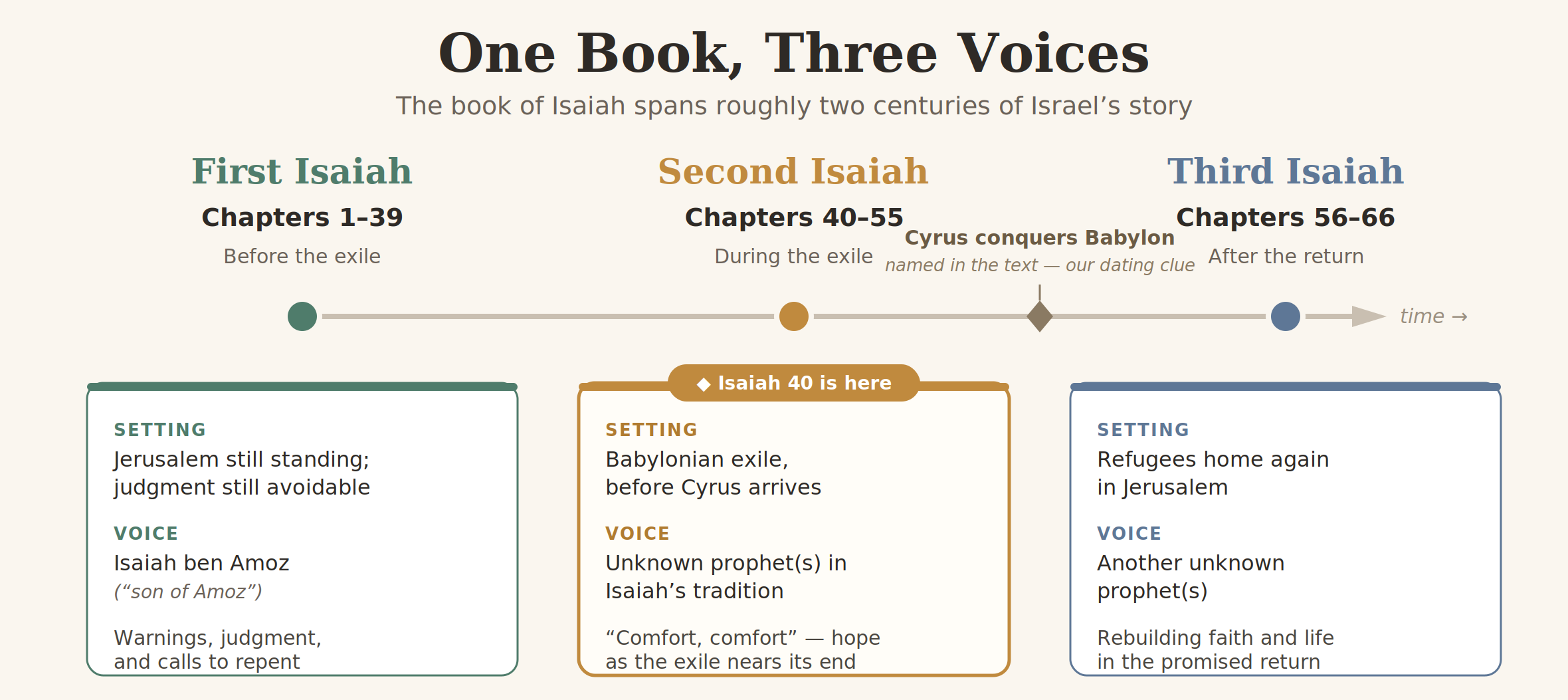
Isaiah is both one book and multiple books. It covers several different time periods in Israel’s history. We see this with the first part being before they were in exile, the second being while they were in Babylonian exile – and we can best date this because it’s before Cyrus came who defeated Babylon and is mentioned by name, and the third section being when the refugees had returned to Jerusalem as promised in the second part.
Could this be the work of one person who happened to have a kind of God-given clairvoyant moment? Perhaps. But this isn’t the popular view in scholarship because
Telling a pre-exile community about hope after exile and into the future – which would be a message for the people 150 years later – isn’t helpful and, therefore, unlikely.
While it contains cohesive themes, there are distinct differences in style at times. (And Deutero/Second Isaiah may have even been a woman based on some of the metaphors used that men didn’t often employ – but that’s a big guess!)
The three different messages build on one another in a way that doesn’t require it.
So we don’t rule it out, but we don’t rule it in really either.
The authors then are Isaiah ben Amoz (son of Amoz) for First Isaiah (1-39), unknown prophet or group of prophets in the tradition of Isaiah ben Amoz (meaning shaped by the message and concepts contained within) for Second Isaiah (40-55), and another unknown prophet or group of prophets for Third Isaiah (56-66).
But we don’t have to know a human author for a text to be inspired, and one person writing it down is not a gold standard that a community of people collecting the written memory doesn’t meet. So much of the Bible has been authored and edited by multiple people. I’d even say most of it, and even some of the ones with names on it (even Paul!).
Reflect: Isaiah’s message came through at least three voices across roughly two centuries, and the community kept it as one book. What does it change for you to think of a text as collected rather than composed — and where did you learn to need a single author before you could trust something?
Isaiah’s Themes
A city-dwelling God
There is a strong relationship drawn between Jerusalem and YHWH. In Deutero-Isaiah, we see this as the prophet tells the people to look for hope in Jerusalem as God is making a way for them.
A “just” life is close to godliness
Like many prophets, justice (mishpat) and righteousness (tzedakah) are of utmost concern. This begins in First Isaiah and continues into Second Isaiah. Together, these two ideals create what we would call the idea of “social justice,” and they are a standard by which God operates and expects the people to.
Reflect: Mishpat and tzedakah are the standard God operates by and expects the people to operate by — not two separate things, but one. Where have you seen those pulled apart, with personal righteousness kept and justice dropped, or the reverse?
Arrogant humanity
First Isaiah homes in on leaning on human systems to make your way. For some people this looked like using the legal system to enrich oneself on the backs of the needy and for the kings and nation overall it looked like political maneuvering that kept dependence on foreign alliances. These also recur in Deutero-Isaiah and particularly here in Isaiah 40 as we will unpack below.
Deutero-Isaiah’s Particular Themes and Isaiah 40
Comfort
The great theme of the book is comfort. This word opens the section and becomes central to later parts of Second Isaiah. God is giving a message of hope to comfort the people as their exile nears its end.
YHWH as a Unique Deity
Throughout the book, we see over and over the idea that no image can represent nor other god compare to YHWH. This is, indeed, the major theme in Isaiah 40 as God works through several layers of people or things that are trusted but ultimately have no power – gods, nations, rulers, images, human strength.
The Servant
You may have heard of Isaiah’s “servant songs,” and often parts of these are quoted as Messianic prophecies. They are in themselves a separate kind of genre within the book, but they aren’t to be separated from it entirely – or read flatly out of context. In Second Isaiah, we will see that in the context Israel is the servant. Cyrus becomes a tool to free the servant, and the nations eventually become beneficiaries of the servant through salvation, but the servant Isaiah discusses is the people of God as represented by Israel first.
Zion as Mother and Herald
Zion is the name of the fortress in Jerusalem, and it is often used as another name for Jerusalem. Throughout Deutero-Isaiah, she will be the mother without her children (as well as other female imagery), and the exiles are the ones she is missing and mourning. In Isaiah 40, she is primarily a herald told to climb to the mountaintop to proclaim God’s approaching the people and making a way in the wilderness for them to come back to her. In this way, she becomes an agent in her own redemption.
God’s Sovereignty Over Everything
Throughout Second Isaiah, we will continue to see God as the true power and ruler over all – nations, gods, rulers, creation. God’s role is active in history as one who intentionally works through political events, and in Isaiah 40, this is contrasted with the “feebleness” of other gods.Eventually, there will be recognition of YHWH by the whole world, according to this chapter.
Motifs from the Hebrew Bible
If you come to know one thing about me, please know it’s that I’m obsessed with how the Bible connects to and borrows from itself. And not only do so many in the NT use Isaiah, but he’s pulling from a rich tradition of story and imagery too.
Genesis 1 is alluded to in chapter 40 – naming parts of it, sharing about God’s role in creation, or creation as a kind of deliverance are all callbacks we see
The Exodus and Call of Moses – the Israelites didn’t call out to God but God heard them – the same is true here, and the arm of YHWH image is used as a way to describe God’s action and strength on Israel’s behalf, and like Moses the confirmation of the prophet’s call is given after the completion.
The Covenant Formula – in earlier Isaiah we see “these people,” but the address now turns to “my people” and “your God” becoming more personal and invoking the coventantal ties from Leviticus and Numbers.
Images and styles reminiscent of other books – Jeremiah and Ezekiel have many common images, and the psalms of lament also show similar style and some similar imagery. And it may be that the prophet is borrowing quite heavily from the hymns and corporate worship of his day.
Words to Know
Let’s have a little vocab lesson. Ready to learn a little Hebrew? It’s important to know when words repeat, because writers in Hebrew love some wordplay. Since part of this passage is a comforting message and another is an argument for trusting God, we see how the prophet connects those two ideas with the words he (or she) chose.
There are several words that link the beginning of chapter 40 with the later half. Below, we will unpack them.
Derek – way, path, road
Where do you see this word showing up in the passage? (Footnote for answer.)1
This also connects to Isaiah 35. The “way” here is early on a highway of sorts. YHWH will flatten mountains and clear trees to make the path for the people to return to Zion. Later on, it will seem that the whole endeavor of returning will also include Israel’s activity and even someone else’s: Cyrus. A “way” is made, but it is connected to the righteousness and activity of Israel as they actively wait and hope.
Kavod – splendor, glory, weight
Where do you find this word in the passage? (Footnote for answer.)2
When used for God, this often connects to a way of praising. Here it attempts to make the abstract more concrete through historical or material manifestations of God. The event of the anticipated future or the past history are ways of describing the God of Israel. These are places God shows up, as it were – the way God reveals Godself. In 40:16, it is used to talk about YHWH’s incomparability. Even the many and well-known cedars of Lebanon are not enough to fuel a sacrifice for God.
Mishpat – decision, judgment, justice
Where is this word in the reading?3
This is a keyword holding together everything from 40:12-42:13. Like the English “judgment,” it can mean to make wise choice or take a wise course, but beneath this word in Isaiah is the idea of authority. God is making decisions about the world. So it becomes a stand in for talking about human rights and what it takes to protect and restore them, in this particular case, it is Israel’s/the exiles’ rights specifically. But later, Israel is, in a sense, accusing God of not doing justice by ignoring the powerless. The mishpat has “escaped” – so in their eyes, justice is not being done. God will answer the charge, but it will be chapter 42.
Reflect: In 40:27 Israel accuses God of letting justice slip. The charge is real, it’s placed in the mouth of the people, and it doesn’t get answered until chapter 42. What’s your relationship to a complaint that stays open — do you tend to withdraw it, answer it yourself, or let it stand?
Tohu – emptiness, void, nothingness
Can you find this word in the passage?4
The word first shows up in chapter 34, and it picks up again throughout Second Isaiah in chapters 40, 41, and 44. It can be emptiness or even the chaos before creation. In this chapter, the rulers and nations – who would typically represent order – are found to be in chaos. They are empty and powerless compared to YHWH. This same nothingness is brought up to describe those who make idols as well. Everything falls short, all human creativity and power, compared to YHWH.
Reflect: Tohu lands on nations and rulers — the very people whose whole claim is that they represent order. What in your own world presents itself as stable, permanent, or simply how things are, that this passage would name as empty?
New Testament References (and Beyond)
John 1: The Word of the Lord from 40:3-5 is put to use to describe the Incarnation
John the Baptist: He uses 40:3-5 to make a connection between God’s promised comfort, salvation, and servant with his ministry that announced the arrival of Jesus
Romans 11:34: Paul quotes 40:13 when speaking of God working in history
Handel’s Messiah: the popular compositions draw heavily on Isaianic literature
Journal Prompts
I’ve included these throughout, but they’re here for you as well in one place.
1. Isaiah’s message came through at least three voices across roughly two centuries, and the community kept it as one book. What does it change for you to think of a text as collected rather than composed — and where did you learn to need a single author before you could trust something?
2. Tohu lands on nations and rulers — the very people whose whole claim is that they represent order. What in your own world presents itself as stable, permanent, or simply how things are, that this passage would name as empty?
3. In 40:27 Israel accuses God of letting justice slip. The charge is real, it’s placed in the mouth of the people, and it doesn’t get answered until chapter 42. What’s your relationship to a complaint that stays open — do you tend to withdraw it, answer it yourself, or let it stand?
4. Mishpat and tzedakah are the standard God operates by and expects the people to operate by — not two separate things, but one. Where have you seen those pulled apart, with personal righteousness kept and justice dropped, or the reverse?
One Thing
If you take one thing from this week, it is the dynamics of empty power — of everything — and full justice when it’s in the hands (or arms) of God.
Tell me in the comments.
If you were to compare the two, what would you say are the characteristics of each?
Moon & Marginalia carries one passage across a lunar month — Widen is where we sit with the waxing moon to see the links in the passage to grow in understanding as the moon grows. The whole Isaiah 40 cycle is free, start to finish. If you want to keep going beyond this cycle, you can upgrade to a paid subscription and get the next cycle and the archives (started August 2026).
Sources consulted include:
The Message of Isaiah 40-55: A Literary-Theological Commentary by John Goldingay
Isaiah, part of The Old Testament Library Series, by Brevard S. Childs
The Prophecy of Isaiah: An introduction & Commentary by J. Alec Motyer
The Queer Bible Commentary.
The Women’s Bible Commentary.
Prophets, from Robert Alter’s translation and commentary of the Hebrew Bible.
Various articles.
Specific citations available upon request — not included due to limited space.
Isaiah 40:3 - the way of YHWH | Isaiah 40:27 - my path is hidden
Isa 40:5 – applied to God | Isa 40:16 – applied to the trees of Lebanon
Isa 40:14 - God needs no one to teach it to him | Isa 40:27 – Israel says theirs has escaped
Isa 40:17 – applied to nations | Isa 40:23 – applied to rulers