

DEEPEN: ISAIAH 40:1-31
🌕 FULL MOON: Look closely at the details – GO HERE 3RD


Moon & Marginalia carries one passage across a lunar month — Deepen is where we meet the full moon to illuminate the details that lead us to understanding the people and the passage more clearly. The whole Isaiah 40 cycle is free, start to finish. If you want to keep going beyond this cycle, you can upgrade to a paid subscription and get the next cycle and the archives (started August 2026).
OVERVIEW
Full Text
40:1-31
Big Idea
The God above all others is making a way home and will sustain them on the journey.
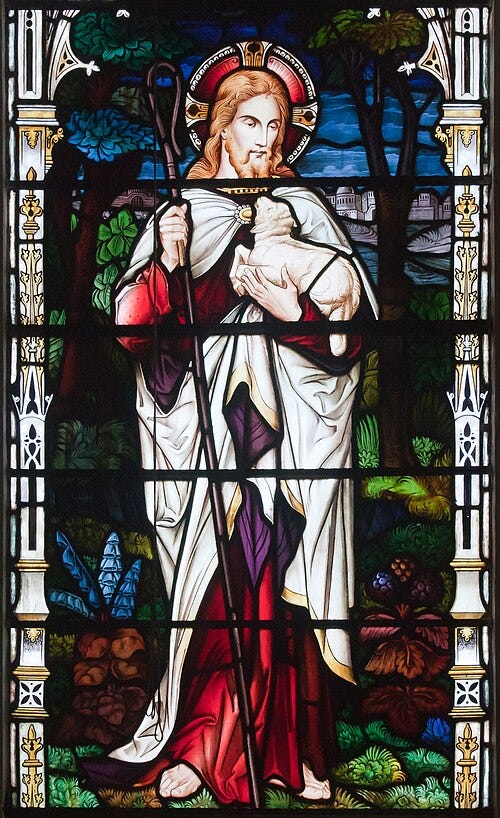
Church of St. Brendan the Navigator, Bantry, County Cork, Ireland
Detail of third window of the south wall with stained glass depicting Isaiah 40:11 He gathers the lambs in his arms. Created by Watson & Co, Youghal, in 1906.
Photo: Andreas F. Borchert, CC BY-SA 3.0 DE, via Wikimedia Commons
DEEPEN
Did you ever get in trouble as a kid, and one parent would look to the other and say, “That’s your kid.”? You should know, that’s kinda how Israel felt after First Isaiah. God and the prophet would use the words “those” or “these” people. But something shifts in Second Isaiah, God is back to “my people.” Then YHWH spends the rest of the time telling them about Godself so they trust in that power to find their comfort — and know the promises the'y’ve received are coming.
This week with the full moon rising, we are drilling further into some details that will help illuminate the passage for us.
Again, go slow, take your time. We’ve got the whole month to sit with the story. So let it marinate a while.
Structure
Before we start — a prophet’s “call” in the Hebrew Bible (especially Isaiah) usually includes:
a) a vision of God’s court
b) a message to carry
c) the prophet feeling unequal to it
d) all three
One of the reasons scholars believe Deutero-Isaiah to be a separate (but continuing) section of Isaiah is because Isaiah 40 has some mirrors of the call of the prophet Isaiah in chapter 6.
If you picked “all three” above, you’ll see this unfold in Isaiah 6 and Isaiah 40 as a new prophet is being called in the exile.
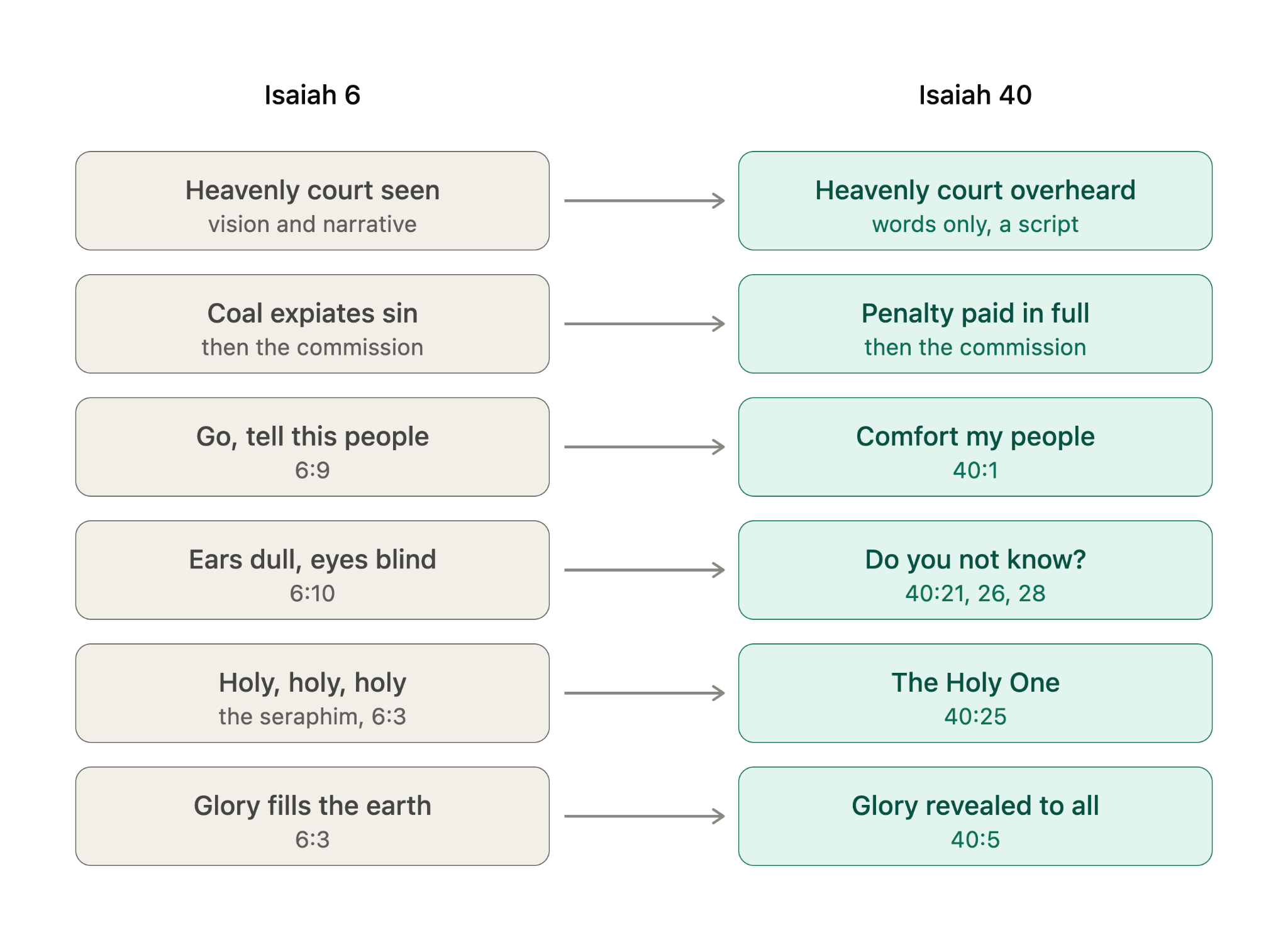
These similarities lead several to believe this is the call and commissioning of a second prophet with a new message – not of judgment and exile but of relief and return.
And above all, it’s a reminder how putting trust in earthly authorities will fall short of YHWH every time.
V 1-11 // God is making a way out of Exile
My sweet dog, Batman, has a loooooooooot of anxiety. It actually stands stronger and taller than mine, and that’s saying something. But he’s my guy, my velcro dog, and I always feel bad when I have to leave the house and him in it. He looks so sad, but on my way out, I always tell him when I’ll be back. It’s not just for him, of course, because while he does have an excellent awareness of time of day, he probably doesn’t understand my sporadic periods out of the house that have no discernible pattern — let alone the words I’m saying to comfort him.
The truth is, I speak those words to comfort myself too. And, on the chance that he does understand, I want him to know that when I come back, I kept my promise and as much as is in my power, I always will. Fortunately for us, God has made such promises AND has the power to always see them through. Here we see that a little in the message of comfort delivered from the jump.
The Heavenly Court
This scene and Isaiah 6 both begin in a “heavenly court.” This is a standard trope in ancient culture, and is used several times in Scripture. It is the place where God/gods meet with a council of sorts (see 1 Kings 22:19 for an example). This gets turned on its head later because we will see YHWH declaring that he needs no such council. Yet, we meet here to start the new chapter of Israel’s history. There is a new message and YHWH is ready to declare it to the new prophet. Often when a prophet appears in the court, it is to plead for the people and to confess their personal weakness to carry out the message. Here, the prophet confesses the people’s weakness.
Pause. Read 40:1–2 out loud. Notice the commands are plural — "comfort" is spoken to a whole court, not one prophet. Who all might God be commissioning?
The Implied Audience
Throughout Second Isaiah, we will see a number of different entities addressees – Jerusalem, the nations, Babylon, Cyrus – but the key audience is the people in exile. Their destiny is connected to all these other entities, but while the explicit “you” changes, the implicit one remains: Judaeans in exile longing for home.
The Lord’s Army?
In this section, we see Jerusalem called on to be a “herald.” (Cue the Christmas carol that just played in your head because it’s how we know what a herald is!) This puts it in the genre of a military instruction – though not necessarily a violence/war context. (And remember, it’s a metaphor — a picture to help the Israelites understand.)
Do you have a guess as to what kind of news a herald would bring — a warning, victory, or something else? (See footnote for answer.)1
Past Promise Now Present
In First Isaiah, the tone and tense is “fear not,” toward people who are still waiting on God’s movement. But chapter 40, in the herald move, speaks as though it has already happened.
Warrior and Shepherd
In the Exodus, YHWH was the warrior who delivered the people. We still see some of that reference here, but God is also a shepherd who cares for the flock. This mirrors how Jacob was a successful shepherd, which brings ties to Israel’s history outside of exile. (And oh boy, do I have a lot to say about this in my upcoming book about David. So stay tuned!)
A message once heard as judgment (Isaiah 6) returns as comfort (Isaiah 40). Where in your own story did something you first received as a verdict later come back to you as mercy?
V 12-17 // The nations cannot compare
Which nations?
There may not appear to be much specificity in the nations in view here, but we do see several in the scope of address.
Babylon holds the exiles
Persia is about to defeat Babylon
Syria and Lebanon whose forests and trees are mentioned
Even Israel itself
There’s a reason that it’s only SO specific. Because the point really is that whatever nation may be that threatens Israel's well-being – even Israel itself – is being put in their place by God.
Pause. Read 40:15 slowly. Picture every nation that has ever frightened you (even your own, perhaps) as a single drop clinging to the bottom of a bucket.
Whole Offering
The word for offering here is olah, and it’s the kind of offering that gets completely burned (versus one that has a reserve for humans).
Why do you think that kind of offering is mentioned specifically? (See footnote for answer.)2
Hope over Humility
In all of that, the big idea isn’t to make Israel feel hopeless – as though no sacrifice is worthy. Rather, we see a payment has already been made to double the standard in Leviticus. Israel feels as though it is nothing compared to the nations that have conquered them and will conquer for them, but God is putting Godself back into view. The nations are nothing before YHWH and no counselor, teacher, or other compares. And that reframe matters as a message of hope and comfort is the goal of the prophet here.
Israel felt like nothing next to the empires that conquered them. What "bigger nation" in your life shrinks the moment you set it beside God instead of beside yourself?
V 18-20 // Other gods do not compare
Manufactured Power
In this section, we see the ways that images of gods are manufactured by humans. Casting, overlaying, and forging are all parts of that process. We may not cast our idols today from stone or gold or iron. Instead, we elevate power, status, admiration, money, and more — whatever category we can create to believe we have stability or that we’ll “win.” But is creator not creation.
Wobbly Gods
In texts of the time, people worried about their idols toppling from their pedestals. The makers of them work tirelessly to ensure it doesn’t happen to threaten the image of their god being represented, but YHWH is not like that. Some scholars compare the manufactured nature of these images to the “Achilles’ heel” of their worship, and they also had this insecurity – electing to create legends about the miraculous origin of some famous images. It reminds me a bit of the myths we’ve made in the past (that still follow us around) about other people being lesser, rather than equal in humanity and worth the same so they deserve dignity and autonomy. Those myths have helped us in raising up our own “gods.”
Marduk vs Monotheism
Babylon’s highest god was Marduk. He was known to be the creator of people, the ruler of the cosmos, and a divine counselor – and still one of many gods. In this passage, we see YHWH subtly declaring their position above all. YHWH is the one who holds all of that and more.
An idol has to be nailed down so it won't topple. What do you spend quiet energy propping up so it won't fall over?
V 21-25 // Rulers do not compare
Back to School
Using words like listening, knowing, and understanding points to this being a kind of classroom. The audience are the students being reminded of what they’ve heard before in First Isaiah and who their teacher is.
Can’t Keep a Good God Down (on Earth)
Whereas as monarchs have thrones in capital cities, God has a throne in the heavens. YHWH dwells in a divine tent spread over the whole earth. Israel’s worship also centered on a particular place – Zion or Jerusalem – but YHWH is not even tethered there. God built the heavens and sits there to rule now.
Pause. Read 40:22. God sits above the circle of the earth — not in any capital, not even tethered to Zion. Where had you pictured God being located?
The Cosmic Gardener
God compares the rulers of the day to plants. They are planted, sown, divided, replanted, etc. They may be part of the life cycle, but even that is interruptible – by just the “wind” of God, ruach.3 That is how quickly and powerfully YHWH can interrupt their cycle.
Overall, this is bad news for those in power, but good news for the powerless at their mercy – because leaders, and therefore, their oppression, will not last forever and God is present and active in that cycle.
This passage calls "permanent" power merely seasonal. What feels fixed and unbudgeable in your world that God would name as grass?
V 26-31 // Human strength does not compare
Weary and Weak
The two words to describe human exhaustion include one focused on weakness from giving out your resources and the other weakness that occurs when you don’t have the opportunity to take in resources. They cover spectrum of why and how humans tire. But God invites them to “renew” their strength.4
Pause. If you can, step outside tonight and read 40:26 under the actual sky: “Lift up your eyes and see who created these.” Then read 40:31 aloud before you come in.
War - What is it Good For?
Again, we see military language. The phrases about young men or chosen men stumbling suggests a reference to armies or military campaigns. The young men fit for war are often the ones who actually expand empires through violence at the command of leaders. So it is probably less about youth and more about imperial power and how it’s obtained.
Active Waiting
The word to wait or hope appears often in the Hebrew Bible, 17 of which occur throughout the Isaiah books. They also appear quite often in the lament Psalms. It’s linked to the idea of tension in a rope or cord. This gives us the picture of “hope as strained expectation.” It’s not about working or passively sitting still. There is tension, stretching, and expectation in the process. But even in the waiting, the prophet puts the focus squarely on divine action.
Where are you "actively waiting" right now, and what would it mean to wait like a pulled cord rather than a slack one?
Back to the Beginning
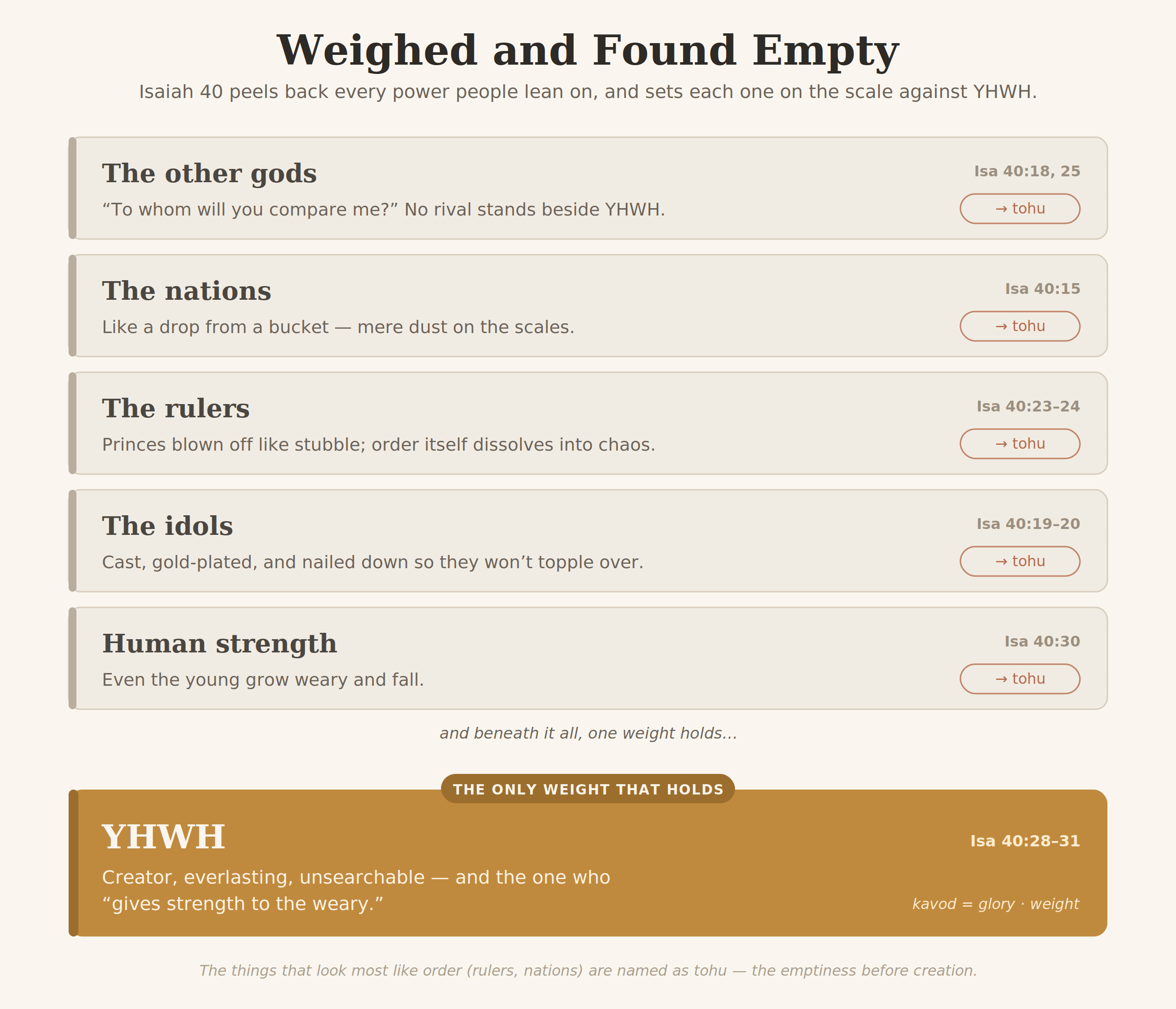
Early in the passage, we see the prophet wondering what to even say and it’s driven home that people, in their feebleness, do not last. But there is something that does: the word of the Lord. And that Lord (in the end of the passage) is the Lasting/Everlasting God – that’s past, present, and future. So the entities that people look to for rescue won’t do it. They are no rival to YHWH, and YHWH has made a promise that will be fulfilled.
One Thing
If you take one thing from this week, it is the dynamics of empty power — of everything — and full justice when it’s in the hands (or arms) of God.
Tell me in the comments.
What are some of the entities you or others you see putting their trust in that are comparatively empty next to the justice of God?
Moon & Marginalia carries one passage across a lunar month — Deepen is where we meet the full moon to illuminate the details that lead us to understanding the people and the passage more clearly. The whole Isaiah 40 cycle is free, start to finish. If you want to keep going beyond this cycle, you can upgrade to a paid subscription and get the next cycle and the archives (started August 2026).
Sources consulted include:
The Message of Isaiah 40-55: A Literary-Theological Commentary by John Goldingay
Isaiah, part of The Old Testament Library Series, by Brevard S. Childs
The Prophecy of Isaiah: An introduction & Commentary by J. Alec Motyer
The Queer Bible Commentary.
The Women’s Bible Commentary.
Prophets, from Robert Alter’s translation and commentary of the Hebrew Bible.
Various articles.
Specific citations available upon request — not included due to limited space.
In the Hebrew Bible, herald is often used of someone declaring news of victory. So the prophet is receiving a kind of military instruction from God to carry home the tiding of good news that they will soon return to the mountaintop of Zion.
The offering here is meant to show us that even the most complete offering, fueled by the trees of the most famous forest in the region, still can’t match up to YHWH.
Ruach can also be “spirit” or “breath.” I chose wind because of the nature connotation here, but being “breath” is also common to see and it’s a simple normal activity that requires no effort.
The Hebrew literally means “exchange.” They can get fresh strength from a new source, YHWH.